Democracy Under Siege: The Crucial Stand of Black Baby Boomers in 2026
In 2026, democracy is under siege. Through King's timeless lens, The Black Baby Boomer names what's happening — and why silence is not an option.
6/6/20264 min read
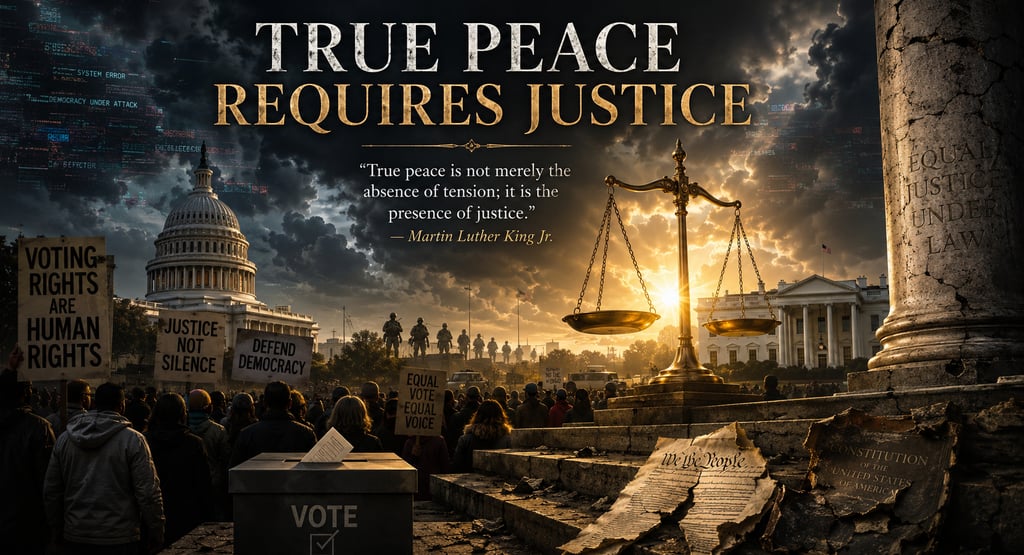
"True peace is not merely the absence of tension;
it is the presence of justice."
— Dr. Martin Luther King Jr.
When Quiet Is Not Peace
The transgressions reshaping American democracy in 2026 are not distant thunder. They are the storm — and silence in the face of them is not calm. It is complicity.
Dr. King did not write those words about a hypothetical America. He wrote them from inside a movement — surrounded by people who wanted the marches to stop, the sit-ins to end, the discomfort of confrontation to dissolve back into a manageable quiet. He understood then what we must understand now: the absence of noise is not justice. It is suppression wearing a suit.
In 2026, that suppression has shed the suit. What we are witnessing across the landscape of American civic life is not ambiguous. It is aggressive, systematic, and accelerating. And for those of us who lived through the first Civil Rights era — who remember what creeping authoritarianism looks like when it is still pretending to be normal — none of this should come as a surprise. But the urgency of it should not be lost on us either.
We were promised a republic. What we are being handed — piece by piece, institution by institution — is a rearrangement of power that serves the powerful and calls it order.
The State of the Republic
Political transgressions in 2026 center on three converging forces: the aggressive consolidation of executive power, the weaponization of trade and regulation as instruments of coercion, and the systematic erosion of civil and human rights across both domestic and international stages. These are not separate crises. They are branches of the same tree.
At home, the current administration has bypassed legislative constraints to launch military actions overseas without congressional authorization — reviving constitutional friction around the War Powers Resolution that has gone deliberately unresolved for decades. The very watchdog institutions designed to check this kind of overreach — an independent judiciary, a protected civil service, a fairly drawn electoral map — are under direct assault. Mass terminations of federal employees, extreme redistricting, and targeted pressure on judges are not isolated incidents. They are a coordinated architecture.
And in the streets, the pressure is showing. Political polarization has produced a sharp rise in civil unrest, with elevated security threats already surrounding the midterm election cycle. We have been here before — 1968 comes to mind — though the infrastructure of surveillance and the sophistication of disinformation campaigns make today's landscape measurably more treacherous.The Transgressions at a Glance
Executive Overreach
Unauthorized military engagements abroad, pursued outside constitutional bounds, have reignited the decades-old battle over the War Powers Resolution and the limits of presidential authority.
Civil Unrest & Election Threat
Polarization and controversial domestic policy have produced surging civic tension — with midterm election cycles now carrying elevated security risk and potential for organized violence.
Democratic Erosio
Watchdog organizations document coordinated attacks on judicial independence, mass civil servant terminations, and extreme redistricting — each one a brick removed from the foundation.
Geopolitical Coercion
Major powers — including the United States — continue weaponizing tariffs and regulatory policy as instruments of economic warfare, destabilizing alliances and rattling global supply chains.
Gray Zone Warfare
The line between peace and war has effectively dissolved, with state and non-state actors conducting infrastructure sabotage and coordinated cyber-disinformation campaigns at unprecedented scale.
What King Understood
Dr. King's framing in Stride Toward Freedom was not merely rhetorical. He was responding to moderates — many of them well-meaning, many of them Black — who counseled patience, decorum, and faith that the system would correct itself in time. He called that counsel what it was: a preference for a negative peace — the peace of the oppressed who have learned not to make noise — over a positive peace built on genuine equity and justice.
We do not have the luxury of the negative peace. Mass deportations. Disinformation infrastructure. Voting rights under siege. These are not the growing pains of a democracy finding its footing. These are intentional. And they land hardest on the communities this platform exists to serve — older Black Americans who built this country, who remember what was promised and what was withheld, and who understand in their bones that justice does not arrive on its own timetable.
King called it clearly: you cannot have peace without justice. Not sustainable peace. Not dignified peace. Not the kind of peace a free people can live in and call a life.
So what does that mean for us — for those of us who are watching, who are tired, who have already marched once in this lifetime and did not imagine we would need to gather our strength and march again?
It means we must stay awake. It means we must translate what we see into language our grandchildren can use. It means we must name what is happening without flinching, vote without letting them make it impossible, and hold on to the moral architecture King gave us — not as nostalgia, but as a navigational tool for terrain he understood better than most.
The tension we feel right now? It is not a malfunction. It is the signal that something is wrong and we still have the conscience to know it. That is not a burden. That is a gift. And it is, if we use it wisely, the very precondition of justice.
"True peace is not merely the absence of tension;
it is the presence of justice."
We will not settle for quiet. We are building something real.
© 2026 · TheBlackBabyBoomer.com · CGM Media · All Rights Reserved