
The Memory That Doesn't Leave — It Just Hides
What the research tells us about multiple sclerosis and memory, and why it matters for how we care for our own.
CarlG
7/12/20264 min read
Somebody in your family knows a woman who "just isn't as sharp as she used to be." Maybe she's the one who used to run the church program from memory, keep every birthday in her head, never miss a bill. Now she writes everything down twice and still forgets. Folks whisper about it. Some call it old age. Some call it stress. But for a good number of us, especially those living with multiple sclerosis, what's actually happening has a name, and it has answers.
Multiple sclerosis (MS) isn't new to our community, but talk about what it does to the mind — not just the legs or the eyes — is still rare at the kitchen table. So let's bring receipts to this conversation, the way we do.
It's More Common Than You'd Think
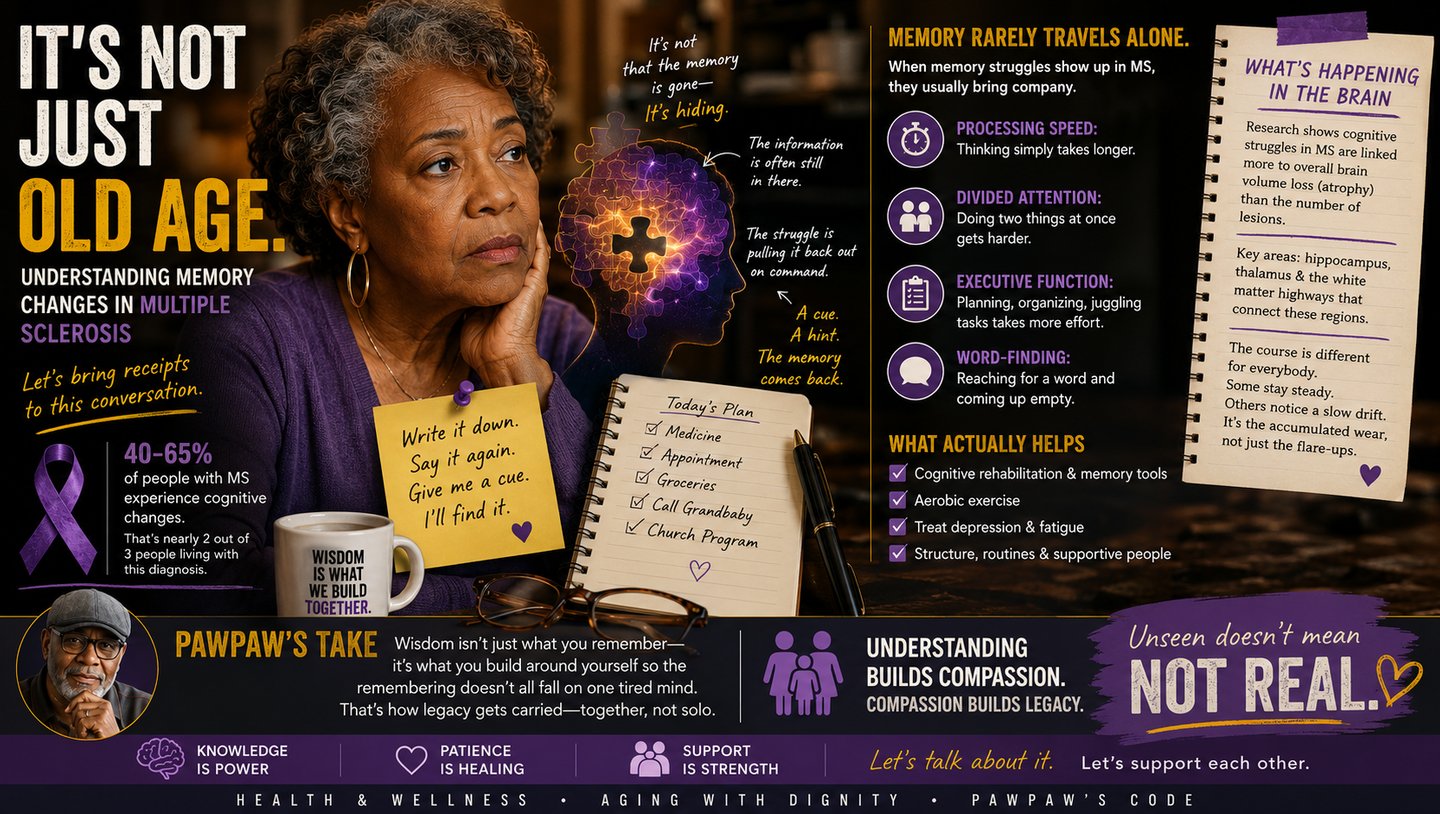
Studies put the number of people with MS who experience some kind of cognitive change — memory, focus, mental speed — at somewhere between 40 and 65 percent. That's not a footnote. That's nearly two out of every three people carrying this diagnosis dealing with something happening upstairs, whether or not their body shows it on the outside.
And here's the part that surprises people: a person can be walking around just fine, driving, working, looking perfectly healthy, and still be fighting real cognitive fog underneath. MS doesn't always show itself in a wheelchair. Sometimes it shows itself in a forgotten appointment or a sentence that trails off mid-thought.
It's Not That the Memory Is Gone — It's Hiding
The information is often still in there. The struggle is pulling it back out on command.
This is the piece worth sitting with. Researchers have found that MS-related memory trouble is usually a retrieval problem, not a storage problem. That's different from something like Alzheimer's, where new information often fails to stick at all.
With MS, the memory frequently gets filed away just fine. The trouble is finding it again on demand — like a book that got shelved in the wrong section of the library. Give someone a hint, a cue, a familiar context, and often the memory comes back. That's why a person with MS might blank on their grandbaby's birthday when asked cold, but light up the second you say "March" or show them the calendar.
This matters for how we treat our people. Impatience and "you should know this" make it worse. A gentle nudge in the right direction often makes it better.
Memory Rarely Travels Alone
When memory struggles show up in MS, they usually bring company. The most consistent troublemaker isn't memory at all — it's processing speed. Thinking simply takes longer. And when thinking takes longer, encoding new memories takes a hit too, which can make memory look worse than it really is.
Divided attention — doing two things at once, like holding a conversation while cooking, gets harder
Executive function — planning, organizing, juggling tasks — takes more effort than it used to
Word-finding — reaching for a word and coming up empty, even a common one
What tends to hold steady: general intelligence, long-held knowledge, and understanding language when it's spoken or read. So the person is not "losing their mind." They're managing a specific, well-documented set of challenges — and that distinction matters for their dignity.
What's Happening in the Brain
Brain imaging research points to a few consistent findings. Cognitive struggles in MS track more closely with overall brain volume loss — atrophy — than with the number of visible lesions. Certain regions matter more than others, particularly the hippocampus (central to memory) and the thalamus, along with the white matter highways that connect these regions to the rest of the brain.
The course is different for everybody. Some people stay steady for years. Others notice a slow drift. And cognitive changes don't always line up with a relapse or a new spot on an MRI — it's the accumulated wear, not just the flare-ups, that tends to predict how the mind is doing.
What Actually Helps
No medication has been shown to reverse memory loss that's already happened, though some disease-modifying therapies may help slow further decline. But there is real, practical help available:
Cognitive rehabilitation — structured strategies, retrieval practice, and tools like planners, alarms, and apps to offload memory work onto something other than the brain
Aerobic exercise — consistently shown to support processing speed and memory, even modest, regular movement
Treating depression and fatigue — both are common companions to MS and both independently make cognitive symptoms worse; treating them often lifts the fog more than people expect
Pawpaw's Take
In my house, we've always said wisdom isn't just what you remember — it's what you build around yourself so the remembering doesn't all fall on one tired mind. A calendar on the wall. A grandchild who reads the pill schedule out loud. A family that gives cues instead of corrections. That's not weakness. That's how legacy actually gets carried — together, not solo.
Why This Belongs in Our Conversation
We are a generation built on carrying things: family stories, church history, recipes with no written measurements, the names of everybody's cousins. When memory starts to slip for someone we love, it can feel like a piece of the family's living archive is at risk. Understanding what MS actually does — and doesn't do — to the mind lets us respond with patience instead of panic, and support instead of shame.
If someone in your circle is living with MS and struggling with memory, encourage a proper neuropsychological evaluation. It sounds clinical, but it's the clearest way to know what's really going on versus what's just worry talking.
— The Black Baby Boomer
Health & Wellness · Aging With Dignity · Pawpaw's Code